FOR THE LOVE OF WISDOM
Man is an inquiring animal. Since the day he developed the power of reflection, he has always posed questions about himself, the world around him, and the purpose and meaning of his existence. Driven as though by a curiosity to know, man has never stopped searching through the ages for an answer to his fundamental queries, to his never-ending quest for knowledge and truth that the spirit of philosophy was born.
Philosophy as part of College or University curriculum still confused many, those who had taken the course and those who intend to take it. For the term Philosophy, in the Filipino mind set, generally connotes fallacious reasoning, id est, Pilosopo.
In the Hiligaynon dialect, Pilosopo is always confused with bertuldo. The latter being the intentional-intellectual act of deceiving another through stealthy changing the meaning of terms for the sake of fun or just sound intelligent. We have had experienced people who are fond of this. As: Malakat ta sa La Salle! And someone answers: Ikaw lang to lakat masakay kami ya! Gaulan mani! Someone answers: manalud ta e, another declares: binaho ta e, then, maligo ta e, mabaho nag id ta e!!! “Kaon anay.” Sigi lang tyay kan-on ya amon ginaka-on”, Kamusta ka? “Mayo man”- Paano nag mayo kay Abril man subong”.
The word philosophy come from the Greek words, philo (love) and sophia (wisdom), and thus, it signifies 'love of wisdom'. This notion of philosophy has always been understood since time immemorial as the serious quest for knowledge of the material world and the endeavor to live 'the good life'. The quest for knowledge in philosophy was never meant to be the easy acceptance of, or conformity to, traditional views or practices. Philosophic knowledge is acquired, as the great philosopher Socrates suggested, through critical inquiry and independent reflection. Thus, if one hopes to have a philosophical understanding of the world and man's place in it, one must appeal to reason rather than to authority, be it tradition or revelation. The search for truth in the realm of philosophy is such a radical venture, that in the process, it may summon to the bar of reason even time- honored beliefs, assumptions and practices of the society. For, as the noted scientist and philosopher Faraday has put it.
...the philosopher should be a man willing to every suggestion, but determined to judge for himself...He should not be biased by appearances; have no favorite hypothesis, be of no school, and in doctrines have no master. He should not be a respecter of person, but of things. Truth should be his primary object.
This critical nature of philosophy may, indeed, prove irreverent and disturbing to many people, specially to those who love intellectual complacency and conformity to established thought. For people, however, who have the passion for critical inquiry, and therefore for the progress of knowledge, philosophy is certainly an exciting and fascinating intellectual adventure.
This is an attempt to make Philosophy deeply appreciated. Again, this is only an attempt to make Philosophy fun to learn and practical to do as well as practical in life. So let us have fun and learn. Or learn to have fun while learning!
FOUR MAIN BRANCHES OF PHILOSOPHY AND ITS CORE SUBJECTS
1. Logic – the science of correct thinking.
2. Ethics – the science of the morality of human acts.
3. Epistemology – the theory of knowledge, the goal of which is truth.
4. Metaphysics – the foundation subject of all philosophy, it deals with human reality and system of human thought that seeks to explain the fundamental concepts of man.
5. Cosmology – the study of inanimate things such as the universe, from the philosophical viewpoint.
6. Aesthetics – the study of beautiful.
7. Rational or philosophical Psychology – the study of life principle of living things, specifically that of man.
8. Theodicy – the philosophical study of God.
9. Social Philosophy – the study of man in relation to the family, the State and the Church.
10.Philosophy of Man – the inquiry into man and his dimensions as persons an as existent being in the world : his dignity, truth, freedom, love, death, his relations with others and with God.
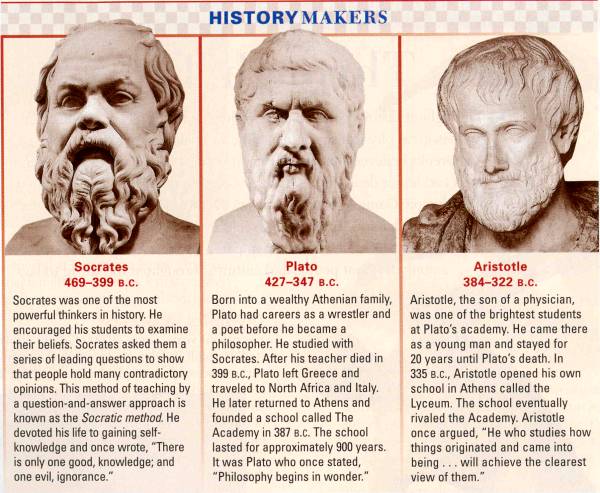
Socrates (470-399) was the son of a sculptor and a midwife, and served with distinction in the Athenian army during Athens’ clash with Sparta. He married, but had a tendency to fall in love with handsome young men, in particular a young soldier named Alcibiades. He was, by all accounts, short and stout, not given to good grooming, and a lover of wine and conversation. His famous student, Plato, called him “the wisest, and justest, and best of all men whom I have ever known” (Phaedo is one of the best-known dialogues of Plato's middle period, along with the Republic and the Symposium. The Phaedo, which depicts the death of Socrates, is also Plato's fourth and last dialogue to detail the philosopher's final days, following Euthyphro, Apology, and Crito.).
He was irritated by the Sophists and their tendency to teach logic as a means of achieving self-centered ends, and even more their promotion of the idea that all things are relative. It was the truth that he loved, desired, and believed in.
Philosophy, the love of wisdom, was for Socrates itself a sacred path, a holy quest -- not a game to be taken lightly. He believed -- or at least said he did in the dialog Meno - is a Socratic dialogue written by Plato. It appears to attempt to determine the definition of virtue, or arete, meaning virtue in general, rather than particular virtues, such as justice or temperance. - in the reincarnation of an eternal soul which contained all knowledge. We unfortunately lose touch with that knowledge at every birth, and so we need to be reminded of what we already know (rather than learning something new).
He said that he did not teach, but rather served, like his mother, as a midwife to truth that is already in us! Making use of questions and answers to remind his students of knowledge is called maieutics (midwifery), dialectics, or the Socratic method.
One example of his effect on philosophy is found in the dialog Euthyphro - is a dialogue that occurs in the weeks before the Trial of Socrates (399 BCE), for which Socrates and Euthyphro attempt to establish a definitive meaning for the word piety (holiness). He suggests that what is to be considered a good act is not good because gods say it is, but is good because it is useful to us in our efforts to be better and happier people. This means that ethics is no longer a matter of surveying the gods or scripture for what is good or bad, but rather thinking about life. He even placed individual conscience above the law -- quite a dangerous position to take!
Socrates himself never wrote any of his ideas down, but rather engaged his students -- wealthy young men of Athens -- in endless conversations. In exchange for his teaching, they in turn made sure that he was taken care of. Since he claimed to have few needs, he took very little, much to his wife Xanthippe’s distress.
Plato reconstructed these discussions in a great set of writings known as the Dialogs. It is difficult to distinguish what is Socrates and what is Plato in these dialogs, so we will simply discuss them together.
Socrates wasn’t loved by everyone by any means. His unorthodox political and religious views gave the leading citizens of Athens the excuse they needed to sentence him to death for corrupting the morals of the youth of the city. In 399, he was ordered to drink a brew of poison hemlock, which he did in the company of his students. The event is documented in Plato's Apology.
Socrates' final words were "Crito, we owe a cock to Asclepius (the god of medicine). Pay it and do not neglect it."
"The unexamined life is not worth living." -- Socrates
Plato (437-347) was Socrates’ prized student. From a wealthy and powerful family, his actual name was Aristocles -- Plato was a nickname, referring to his broad physique. When he was about twenty, he came under Socrates’ spell and decided to devote himself to philosophy. Devastated by Socrates’ death, he wandered around Greece and the Mediterranean and was taken by pirates. His friends raised money to ransom him from slavery, but when he was released without it, they bought him a small property called Academus to start a school -- the Academy, founded in 386.
The Academy was more like Pythagorus’ community -- a sort of quasi-religious fraternity, where rich young men studied mathematics, astronomy, law, and, of course, philosophy. It was free, depending entirely on donations. True to his ideals, Plato also permitted women to attend! The Academy would become the center of Greek learning for almost a millennium.
Plato can be understood as idealistic and rationalistic, much like Pythagorus but much less mystical. He divides reality into two: On the one hand we have ontos, idea or ideal. This is ultimate reality, permanent, eternal, spiritual. On the other hand, there’s phenomena, which is a manifestation of the ideal. Phenomena are appearances -- things as they seem to us -- and are associated with matter, time, and space.
Phenomena are illusions which decay and die. Ideals are unchanging, perfect. Phenomena are definitely inferior to Ideals! The idea of a triangle -- the defining mathematics of it, the form or essence of it -- is eternal. Any individual triangle, the triangles of the day-to-day experiential world, are never quite perfect: They may be a little crooked, or the lines a little thick, or the angles not quite right.... They only approximate that perfect triangle, the ideal triangle.
If it seems strange to talk about ideas or ideals as somehow more real than the world of our experiences, consider science. The law of gravity, 1+1=2, “magnets attract iron,” E=mc2, and so on -- these are universals, not true for one day in one small location, but true forever and everywhere! If you believe that there is order in the universe, that nature has laws, you believe in ideas!
Ideas are available to us through thought, while phenomena are available to us through our senses. So, naturally, thought is a vastly superior means to get to the truth. This is what makes Plato a rationalist, as opposed to an empiricist, in epistemology.
Senses can only give you information about the ever-changing and imperfect world of phenomena, and so can only provide you with implications about ultimate reality, not reality itself. Reason goes straight to the idea. You “remember,” or intuitively recognize the truth, as Socrates suggested in the dialog Meno.
According to Plato, the phenomenal world strives to become ideal, perfect, complete. Ideals are, in that sense, a motivating force. In fact, he identifies the ideal with God and perfect goodness. God creates the world out of materia (raw material, matter) and shapes it according to his “plan” or “blueprint” -- ideas or the ideal. If the world is not perfect, it is not because of God or the ideals, but because the raw materials were not perfect. I think you can see why the early Christian church made Plato an honorary Christian, even though he died three and a half centuries before Christ!
Plato applies the same dichotomy to human beings: There’s the body, which is material, mortal, and “moved” (a victim of causation). Then there’s the soul, which is ideal, immortal, and “unmoved” (enjoying free will).
The soul includes reason, of course, as well as self-awareness and moral sense. Plato says the soul will always choose to do good, if it recognizes what is good. This is a similar conception of good and bad as the Buddhists have: Rather than bad being sin, it is considered a matter of ignorance. So, someone who does something bad requires education, not punishment.
The soul is drawn to the good, the ideal, and so is drawn to God. We gradually move closer and closer to God through reincarnation as well as in our individual lives. Our ethical goal in life is resemblance to God, to come closer to the pure world of ideas and ideal, to liberate ourselves from matter, time, and space, and to become more real in this deeper sense. Our goal is, in other words, self-realization.
Plato talks about three levels of pleasure. First is sensual or physical pleasure, of which sex is a great example. A second level is sensuous or esthetic pleasure, such as admiring someone’s beauty, or enjoying one’s relationship in marriage. But the highest level is ideal pleasure, the pleasures of the mind. Here the example would be Platonic love, intellectual love for another person unsullied by physical involvement.
Paralleling these three levels of pleasure are three souls. We have one soul called appetite, which is mortal and comes from the gut. The second soul is called spirit or courage. It is also mortal, and lives in the heart. The third soul is reason. It is immortal and resides in the brain. The three are strung together by the cerebrospinal canal.
Plato is fond of analogies. Appetite, he says, is like a wild horse, very powerful, but likes to go its own way. Spirit is like a thoroughbred, refined, well trained, directed power. And reason is the charioteer, goal-directed, steering both horses according to his will.
Other analogies abound, especially in Plato’s greatest work, The Republic. In The Republic, he designs (through Socrates) a society in order to discover the meaning of justice. Along the way, he compares elements of his society (a utopia, Greek for “no place”) to the three souls: The peasants are the foundation of the society. They till the soil and produce goods, i.e. take care of society’s basic appetites. The warriors represent the spirit and courage of the society. And the philosopher kings guide the society, as reason guides our lives.
Before you assume that we are just looking at a Greek version of the Indian caste system, please note: Everyone’s children are raised together and membership in one of the three levels of society is based on talents, not on one’s birth parents! And Plato includes women as men’s equals in this system.
Aristotle (384-322) was born in a small Greek colony in Thrace called Stagira. His father was a physician and served the grandfather of Alexander the Great. Presumably, it was his father who taught him to take an interest in the details of natural life.
He was Plato’s prize student, even though he disagreed with him on many points. When Plato died, Aristotle stayed for a while with another student of Plato, who had made himself a dictator in northern Asia Minor. He married the dictator’s daughter, Pythias. They moved to Lesbos, where Pythias died giving birth to their only child, a daughter. Although he married again, his love for Pythias never died, and he requested that they be buried side by side.
For four years, Aristotle served as the teacher of a thirteen year old Alexander, son of Philip of Macedon. In 334, he returned to Athens and established his school of philosophy in a set of buildings called the Lyceum (from a name for Apollo, “the shepherd”). The beautiful grounds and covered walkways were conducive to leisurely walking discussions, so the students were known as peripatoi (“covered walkways”).
First, we must point out that Aristotle was as much a scientist as a philosopher. He was endlessly fascinated with nature, and went a long way towards classifying the plants and animals of Greece. He was equally interested in studying the anatomies of animals and their behavior in the wild.
Aristotle also pretty much invented modern logic. Except for its symbolic form, it is essentially the same today.
Let’s begin with metaphysics: While Plato separates the ever-changing phenomenal world from the true and eternal ideal reality, Aristotle suggests that the ideal is found “inside” the phenomena, the universals “inside” the particulars.
What Plato called idea or ideal, Aristotle called essence, and its opposite, he referred to as matter. Matter is without shape or form or purpose. It is just “stuff.” pure potential, no actuality. Essence is what provides the shape or form or purpose to matter. Essence is “perfect,” “complete,” but it has no substance, no solidity. Essence and matter need each other!
Essence realizes (“makes real”) matter. This process, the movement from formless stuff to complete being, is called entelechy, which some translate as actualization.
There are four causes that contribute to the movement of entelechy. They are answers to the question “why?” or “what is the explanation of this?”
1. The material cause: what something is made of. (is that from which a thing comes to be)
2. The efficient cause: the motion or energy that changes matter. (is that by which a thing comes to be)
3. The formal cause: the thing’s shape, form, or essence; its definition. (is that by which a thing what it is)
4. The final cause: its reason, its purpose, the intention behind it. (is that for which a thing comes to be)
1. The material cause: The thing’s matter or substance. Why a bronze statue? The metal it is made of. Today, we find an emphasis on material causation in reductionism, explaining, for example, thoughts in terms of neural activity, feelings in terms of hormones, etc. We often go down a “level” because we can’t explain something at the level it’s at.
2. The efficient cause: The motion or energy that changes matter. Why the statue? The forces necessary to work the bronze, the hammer, the heat, the energy.... This is what modern science focuses on, to the point where this is what cause now tends to mean, exclusively. Note that modern psychology usually relies on reductionism in order to find efficient causes. But it isn’t always so: Freud, for example, talked about psychosexual energy and Skinner talked about stimulus and response.
3. The formal cause: The thing’s shape, form, definition, or essence. Why the statue? Because of the plan the sculptor had for the bronze, it’s shape or form, the non-random ordering of it’s matter. In psychology, we see some theorists focus on structure -- Piaget and his schema, for example. Others talk about the structure inherent in the genetic code, or about cognitive scripts.
4. The final cause: The end, the purpose, the teleology of the thing. Why the statue? The purpose of it, the intention behind making it. This was popular with medieval scholars: They searched for the ultimate final cause, the ultimate purpose of all existence, which they of course labeled God! Note that, outside of the hard sciences, this is often the kind of cause we are most interested in: Why did he do it, what was his purpose or intention? E.g. in law, the bullet may have been the “efficient” cause of death, but the intent of the person pulling the trigger is what we are concerned with. When we talk about intentions, goals, values, and so on, we are talking about final causes.
Aristotle wrote the first book on psychology (as a separate topic from the rest of philosophy). It was called, appropriately, Para Psyche, Greek for “about the mind or soul.” It is better known in the Latin form, De Anima. In this book, we find the first mentions of many ideas that are basic to psychology today, such as the laws of association.
In it, he says the mind or soul is the “first entelechy” of the body, the “cause and principle” of the body, the realization of the body. We might put it like this: The mind is the purposeful functioning of the nervous system.
Like Plato, he postulates three kinds of souls, although slightly differently defined. There is a plant soul, the essence of which is nutrition. Then there is an animal soul, which contains the basic sensations, desire, pain and pleasure, and the ability to cause motion. Last, but not least, is the human soul. The essence of the human soul is, of course, reason. He suggests that, perhaps, this last soul is capable of existence apart from the body.
He foreshadowed many of the concepts that would become popular only two thousand years later. Libido, for example: “In all animals... it is the most natural function to beget another being similar to itself... in order that they attain as far as possible, the immortal and divine.... This is the final cause of every creatures natural life.”
And the struggle of the id and ego: “There are two powers in the soul which appear to be moving forces -- desire and reason. But desire prompts actions in violation of reason... desire... may be wrong.”
And the pleasure principle and reality principle: “Although desires arise which are opposed to each other, as is the case when reason and appetite are opposed, it happens only in creatures endowed with a sense of time. For reason, on account of the future, bids us resist, while desire regards the present; the momentarily pleasant appears to it as the absolutely pleasant and the absolutely good, because it does not see the future.”
And finally, self-actualization: We begin as unformed matter in the womb, and through years of development and learning, we become mature adults, always reaching for perfection. "So the good has been well explained as that at which all things aim."
“Man is by nature a social animal; an individual who is unsocial naturally and not accidentally is either beneath our notice or more than human. Society is something that precedes the individual. Anyone who either cannot lead the common life or is so self-sufficient as not to need to, and therefore does not partake of society, is either a beast or a god. ”
"Happiness depends on ourselves." More than anybody else, Aristotle enshrines happiness as a central purpose of human life and a goal in itself. As a result he devotes more space to the topic of happiness than any thinker prior to the modern era. Living during the same period as Mencius, but on the other side of the world, he draws some similar conclusions. That is, happiness depends on the cultivation of virtue, though his virtues are somewhat more individualistic than the essentially social virtues of the Confucians. Yet as we shall see, Aristotle was convinced that a genuinely happy life required the fulfillment of a broad range of conditions, including physical as well as mental well-being. In this way he introduced the idea of a science of happiness in the classical sense, in terms of a new field of knowledge.
HAPPINESS AS THE ULTIMATE PURPOSE OF HUMAN EXISTENCE
One of Aristotle's most influential works is the Nicomachean Ethics, where he presents a theory of happiness that is still relevant today, over 2,300 years later. The key question Aristotle seeks to answer in these lectures is "What is the ultimate purpose of human existence?" What is that end or goal for which we should direct all of our activities? Everywhere we see people seeking pleasure, wealth, and a good reputation. But while each of these has some value, none of them can occupy the place of the chief good for which humanity should aim. To be an ultimate end, an act must be self-sufficient and final, "that which is always desirable in itself and never for the sake of something else" (Nicomachean Ethics, 1097a30-34), and it must be attainable by man. Aristotle claims that nearly everyone would agree that happiness is the end which meets all these requirements. It is easy enough to see that we desire money, pleasure, and honor only because we believe that these goods will make us happy. It seems that all other goods are a means towards obtaining happiness, while happiness is always an end in itself.
The Greek word that usually gets translated as "happiness" is eudaimonia, and like most translations from ancient languages, this can be misleading. The main trouble is that happiness (especially in modern America) is often conceived of as a subjective state of mind, as when one says one is happy when one is enjoying a cool beer on a hot day, or is out "having fun" with one's friends. For Aristotle, however, happiness is a final end or goal that encompasses the totality of one's life. It is not something that can be gained or lost in a few hours, like pleasurable sensations. It is more like the ultimate value of your life as lived up to this moment, measuring how well you have lived up to your full potential as a human being. For this reason, one cannot really make any pronouncements about whether one has lived a happy life until it is over, just as we would not say of a football game that it was a "great game" at halftime (indeed we know of many such games that turn out to be blowouts or duds). For the same reason we cannot say that children are happy, any more than we can say that an acorn is a tree, for the potential for a flourishing human life has not yet been realized. As Aristotle says, "for as it is not one swallow or one fine day that makes a spring, so it is not one day or a short time that makes a man blessed and happy." (Nicomachean Ethics, 1098a18)
THE HIERARCHICAL VIEW OF NATURE
In order to explain human happiness, Aristotle draws on a view of nature he derived from his biological investigations. If we look at nature, we notice that there are four different kinds of things that exist in the world, each one defined by a different purpose:
Mineral: rocks, metals and other lifeless things. The only goal which these things seek is to come to a rest. They are "beyond stupid" since they are inanimate objects with no soul
Vegetative: plants and other wildlife. Here we see a new kind of thing emerge,something which is alive. Because plants seek nourishment and growth, they have souls and can be even said to be satisfied when they attain these goals
Animal: all the creatures we study as belonging to the animal kingdom. Here we see a higher level of life emerge: animals seek pleasure and reproduction, and we can talk about a happy or sad dog, for example, to the extent that they are healthy and lead a pleasant life
Human: what is it that makes human beings different from the rest of the animal kingdom? Aristotle answers: Reason. Only humans are capable of acting according to principles, and in so doing taking responsibility for their choices. We can blame Johnny for stealing the candy since he knows it is wrong, but we wouldn't blame an animal since it doesn't know any better.
It seems that our unique function is to reason: by reasoning things out we attain our ends, solve our problems, and hence live a life that is qualitatively different in kind from plants or animals. The good for a human is different from the good for an animal because we have different capacities or potentialities. We have a rationalcapacity and the exercising of this capacity is thus the perfecting of our natures as human beings. For this reason, pleasure alone cannot constitute human happiness, for pleasure is what animals seek and human beings have higher capacities than animals. The goal is not to annihilate our physical urges, however, but rather to channel them in ways that are appropriate to our natures as rational animals.
Thus Aristotle gives us his definition of happiness:
...the function of man is to live a certain kind of life, and this activity implies a rational principle, and the function of a good man is the good and noble performance of these, and if any action is well performed it is performed in accord with the appropriate excellence: if this is the case, then happiness turns out to be an activity of the soul in accordance with virtue. (Nicomachean Ethics, 1098a13)
THE PURSUIT OF HAPPINESS AS THE EXERCISE OF VIRTUE
In this last quote we can see another important feature of Aristotle's theory: the link between the concepts of happiness and virtue. Aristotle tells us that the most important factor in the effort to achieve happiness is to have a good moral character — what he calls "complete virtue." But being virtuous is not a passive state: one must act in accordance with virtue. Nor is it enough to have a few virtues; rather one must strive to possess all of them.
THE GOLDEN MEAN
Aristotle’s ethics is sometimes referred to as “virtue ethics” since its focus is not on the moral weight of duties or obligations, but on the development of character and the acquiring of virtues such as courage, justice, temperance, benevolence, and prudence. And anyone who knows anything about Aristotle has heard his doctrine of virtue as being a “golden mean” between the extremes of excess and deficiency. Courage, for example, is a mean regarding the feeling of fear, between the deficiency of rashness (too little fear) and the excess of cowardice (too much fear). Justice is a mean between getting or giving too much and getting or giving too little. Benevolence is a mean between giving to people who don’t deserve it and not giving to anyone at all. Aristotle is not recommending that one should be moderate in all things, since one should at all times exercise the virtues. One can’t reason "I should be cruel to my neighbor now since I was too nice to him before." The mean is a mean between two vices, and not simply a mean between too much and too little.
Furthermore, the mean is “relative to ourselves,” indicating that one person’s mean may be another person’s extreme. Milo the wrestler, as Aristotle puts it, needs more gruel than a normal person, and his mean diet will vary accordingly. Similarly for the moral virtues. Aristotle suggests that some people are born with weaker wills than others; for these people, it may actually be a mean to flee in battle (the extremes being to get slaughtered or commit suicide). Here we see the flexibility in Aristotle’s account: as soon as he begins to lay down some moral rules, he relaxes them in order to take into consideration the variety and contingency of particular temperaments.
Aristotle’s doctrine of the mean is well in keeping with ancient ways of thinking which conceived of justice as a state of equilibrium between opposing forces. In the early cosmologies, the Universe is stabilized as a result of the reconciliation between the opposing forces of Chaos and Order. The Greek philosopher Heraclitus conceived of right living as acting in accordance with the Logos, the principle of the harmony of opposites; and Plato defined justice in the soul as the proper balance among its parts. Like Plato, Aristotle thought of the virtuous character along the lines of a healthy body. According to the prevailing medical theory of his day, health in the body consists of an appropriate balance between the opposing qualities of hot, cold, the dry, and the moist. The goal of the physician is to produce a proper balance among these elements, by specifying the appropriate training and diet regimen, which will of course be different for every person.
Similarly with health in the soul: exhibiting too much passion may lead to reckless acts of anger or violence which will be injurious to one’s mental well-being as well as to others; but not showing any passion is a denial of one’s human nature and results in the sickly qualities of morbidity, dullness, and antisocial behavior. The healthy path is the “middle path,” though remember it is not exactly the middle, given that people who are born with extremely passionate natures will have a different mean than those with sullen, dispassionate natures. Aristotle concludes that goodness of character is “a settled condition of the soul which wills or chooses the mean relatively to ourselves, this mean being determined by a rule or whatever we like to call that by which the wise man determines it.” (Nicomachean Ethics, 1006b36)
According to Aristotle, what is happiness?
- Happiness is the ultimate end and purpose of human existence
- Happiness is not pleasure, nor is it virtue. It is the exercise of virtue.
- Happiness cannot be achieved until the end of one's life. Hence it is a goal and not a temporary state.
- Happiness is the perfection of human nature. Since man is a rational animal, human happiness depends on the exercise of his reason.
- Happiness depends on acquiring a moral character, where one displays the virtues of courage, generosity, justice, friendship, and citizenship in one's life. These virtues involve striking a balance or "mean" between an excess and a deficiency.
- Happiness requires intellectual contemplation, for this is the ultimate realization of our rational capacities.
Reflections On Man
- Man is the measure of himself. (Protagoras)
- That which does not kill you makes you stronger. (Friedrich Nietzsche)
- All men are bad and ever ready to display their vicious nature, whenever they may find occasion for it. (Nicolo Machiavelli)
- Man when perfected by law is the best of animals, but when separated from law, he is the worst of all. (Aristotle)
- No man is free who cannot command or control himself. (Pythagoras)
- Man is the master of his fate and the captain of his soul. (Henley, Poet)
- Before the cosmos, Man is but a dot, yet he thinks and loves, while the world cannot. ( F.M., Social Philosopher)
- Man is the only being that changes constantly yet remains unchanged by change. (Felix Montemayor, Social Philosopher)
- “All real living is meeting” (Martin Buber)
- "The unexamined life is not worth living" (Socrates)
- The superior man will watch over himself when she is alone. He examines his heart that there may be nothing wrong there and that he may have no dissatisfaction with himself. (Confucius)
- Man is not only body, but he is something infinitely higher. Of all animal creation of God, man is the only animal who has been created in order that he may know his Maker. Man's aim in life is not to add from day to day to his material possessions, but his predominant calling is from day to day nearer to his own maker. (Gandhi)
St. Thomas Aquinas
Italian Dominican theologian St. Thomas Aquinas was one of the most influential medieval thinkers of Scholasticism and the father of the Thomistic school of theology.
Philosopher and theologian St. Thomas Aquinas was born circa 1225 in Roccasecca, Italy. Combining the theological principles of faith with the philosophical principles of reason, he ranked among the most influential thinkers of medieval Scholasticism. An authority of the Roman Catholic Church and a prolific writer, Aquinas died on March 7, 1274, at the Cistercian monastery of Fossanova, near Terracina, Latium, Papal States, Italy.
The son of Landulph, count of Aquino, St. Thomas Aquinas was born circa 1225 in Roccasecca, Italy, near Aquino, Terra di Lavoro, in the Kingdom of Sicily. Thomas had eight siblings, and was the youngest child. His mother, Theodora, was countess of Teano. Though Thomas's family members were descendants of Emperors Frederick I and Henry VI, they were considered to be of lower nobility.
Before St. Thomas Aquinas was born, a holy hermit shared a prediction with his mother, foretelling that her son would enter the Order of Friars Preachers, become a great learner and achieve unequaled sanctity.
Following the tradition of the period, St. Thomas Aquinas was sent to the Abbey of Monte Cassino to train among Benedictine monks when he was just 5 years old. In Wisdom 8:19, St. Thomas Aquinas is described as "a witty child" who "had received a good soul." At Monte Cassino, the quizzical young boy repeatedly posed the question, "What is God?" to his benefactors.
St. Thomas Aquinas remained at the monastery until he was 13 years old, when the political climate forced him to return to Naples.
Education
St. Thomas Aquinas spent the next five years completing his primary education at a Benedictine house in Naples. During those years, he studied Aristotle's work, which would later become a major launching point for St. Thomas Aquinas's own exploration of philosophy. At the Benedictine house, which was closely affiliated with the University of Naples, Thomas also developed an interest in more contemporary monastic orders. He was particularly drawn to those that emphasized a life of spiritual service, in contrast with the more traditional views and sheltered lifestyle he'd observed at the Abbey of Monte Cassino.
Circa 1239, St. Thomas Aquinas began attending the University of Naples. In 1243, he secretly joined an order of Dominican monks, receiving the habit in 1244. When his family found out, they felt so betrayed that he had turned his back on the principles to which they subscribed that they decided to kidnap him. Thomas's family held him captive for an entire year, imprisoned in the fortress of San Giovanni at Rocca Secca. During this time, they attempted to deprogram Thomas of his new beliefs. Thomas held fast to the ideas he had learned at university, however, and went back to the Dominican order following his release in 1245.
From 1245 to 1252, St. Thomas Aquinas continued to pursue his studies with the Dominicans in Naples, Paris and Cologne. He was ordained in Cologne, Germany, in 1250, and went on to teach theology at the University of Paris. Under the tutelage of St. Albert the Great, St. Thomas Aquinas subsequently earned his doctorate in theology. Consistent with the holy hermit's prediction, Thomas proved an exemplary scholar, though, ironically, his modesty sometimes led his classmates to misperceive him as dim-witted. After reading Thomas's thesis and thinking it brilliant, his professor, St. Albert the Great, proclaimed in Thomas's defense, "We call this young man a dumb ox, but his bellowing in doctrine will one day resound throughout the world!"
St. Thomas Aquinas: The Existence of God can be proved in five ways. Analysis of the Five Ways
- The First Way: Argument from Motion
Our senses prove that some things are in motion.
Things move when potential motion becomes actual motion.
Only an actual motion can convert a potential motion into an actual motion.
Nothing can be at once in both actuality and potentiality in the same respect (i.e., if both actual and potential, it is actual in one respect and potential in another).Therefore nothing can move itself. Therefore each thing in motion is moved by something else. The sequence of motion cannot extend ad infinitum. Therefore it is necessary to arrive at a first mover, put in motion by no other; and this everyone understands to be God.
- The Second Way: Argument from Efficient Causes
We perceive a series of efficient causes of things in the world.
Nothing exists prior to itself. Therefore nothing is the efficient cause of itself. If a previous efficient cause does not exist, neither does the thing that result. Therefore if the first thing in a series does not exist, nothing in the series exists. The series of efficient causes cannot extend ad infinitum into the past, for then there would be no things existing now.
Therefore it is necessary to admit a first efficient cause, to which everyone gives the name of God.
- The Third Way: Argument from Possibility and Necessity
We find in nature things that are possible to be and not to be, that come into being and go out of being i.e., contingent beings. Assume that every being is a contingent being. For each contingent being, there is a time it does not exist. Therefore it is impossible for these always to exist. Therefore there could have been a time when no things existed. Therefore at that time there would have been nothing to bring the currently existing contingent beings into existence. Therefore, nothing would be in existence now.
We have reached an absurd result from assuming that every being is a contingent being. Therefore not every being is a contingent being.
Therefore some being exists of its own necessity, and does not receive its existence from another being, but rather causes them. This all men speak of as God.
- The Fourth Way: Argument from Gradation of Being
There is a gradation to be found in things: some are better or worse than others. Predications of degree require reference to the “uttermost” case (e.g., a thing is said to be hotter according as it more nearly resembles that which is hottest). The maximum in any genus is the cause of all in that genus.
Therefore there must also be something which is to all beings the cause of their being, goodness, and every other perfection; and this we call God.
- The Fifth Way: Argument from Design
We see that natural bodies work toward some goal, and do not do so by chance. Most natural things lack knowledge. But as an arrow reaches its target because it is directed by an archer, what lacks intelligence achieves goals by being directed by something intelligence. Therefore some intelligent being exists by whom all natural things are directed to their end; and this being we call God.
After reading Thomas's thesis and thinking it brilliant, his professor, St. Albert the Great, proclaimed in Thomas's defense, "We call this young man a dumb ox, but his bellowing in doctrine will one day resound throughout the world!"
The Problem of Evil
"Evil" has a wider range of definitions than that for which human or supernatural agents are responsible.
There are types of evil:
- Moral evil - This covers the willful acts of human beings (such as murder, rape, etc.)
- Natural evil - This refers to natural disasters (such as famines, floods, etc.)
Of these two types, we may further divide both of them into the following two classes:
- Physical evil - This means bodily pain or mental anguish (fear, illness, grief, etc.)
- Metaphysical evil - This refers to such things as imperfection and chance (criminals going unpunished, deformities, etc.)
When Good Men Do Nothing
"All that is necessary for the triumph of evil is that good men do nothing." (Edmund Burke)
So much of the history of the struggle between good and evil can be explained by Edmund Burke's observation. Time and again those who profess to be good seem to clearly outnumber those who are evil, yet those who are evil seem to prevail far too often. Seldom is it the numbers that determine the outcome, but whether those who claim to be good men are willing to stand up and fight for what they know to be right. There are numerous examples of this sad and awful scenario being played out over and over again in the scriptures.
They Get Nothing Good Done
When good men do nothing, they get nothing good done. To be good, one must do good. The Lord commands his people to do good (Luke 6:35; Eph. 2:10). Christ "gave himself for us, that he might redeem us from all iniquity, and purify unto himself a peculiar people, zealous of good works" (Titus 2:14).
Question: "Did God create evil?"
Answer: At first it might seem that if God created all things then evil must have been created by God. However, there is an assumption here that needs to be cleared up. Evil is not a "thing" like a rock or electricity. You can't have a jar of evil! Rather, evil is something that occurs, like running. Evil has no existence of its own; it is really a lack in a good thing. For example, holes are real but they only exist in something else. We call the absence of dirt a hole, but it cannot be separated from the dirt. So when God created, it is true that all that existed was good. One of the good things that God made was creatures who had the freedom to choose good. In order to have a real choice, God had to allow there to be something besides good to choose. So God allowed these free angels and humans to choose good or non-good (evil). When a bad relationship exists between two good things we call that evil, but it does not become a "thing" that required God to create it.
Perhaps a further illustration will help. If I were to ask the average person "does cold exist?" his/her answer would likely be yes. However, this is incorrect. Cold does not exist. Cold is the absence of heat. Similarly, darkness does not exist. Darkness is the absence of light. Similarly, evil is the absence of good, or better, evil is the absence of God. God did not have to create evil, but rather only allow for the absence of good.
Look at the example of Job in Job chapters 1-2. Satan wanted to destroy Job, and God allowed Satan to do everything but kill him. God allowed this to happen to prove to Satan that Job was righteous because he loved God, not because God had blessed him so richly. God is sovereign and ultimately in control of everything that happens. Satan cannot do anything unless he has God's "permission." God did not create evil, but He allows evil. If God had not allowed for the possibility of evil, both mankind and angels would be serving God out of obligation, not choice. He did not want “robots” that simply did what He wanted them to do because of their "programming." God allowed for the possibility of evil so that we could genuinely have a free will and choose whether we wanted to serve Him or not.
Ultimately, there is not an answer to these questions that we can fully comprehend. We, as finite human beings, can never fully understand an infinite God (Romans 11:33-34). Sometimes we think we understand why God is doing something, only to find out later that it was for a different purpose than we originally thought. God looks at things from an eternal perspective. We look at things from an earthly perspective. Why did God put man on earth knowing that Adam and Eve would sin and therefore bring evil, death, and suffering on all mankind? Why didn’t He just create us all and leave us in heaven where we would be perfect and without suffering? The best answer we can come up with is this: God didn’t want a race of robots who did not have a free will. God had to allow the possibility of evil for us to have a true choice of whether to worship God or not. If we never had to suffer and experience evil, would we truly know how wonderful heaven is? God did not create evil, but He allowed it. If He hadn’t allowed evil, we would be worshiping Him out of obligation, not by a choice of our own free will.
Siddhartha Gautama
Born in Nepal in the 6th century B.C., Buddha was a spiritual leader and teacher whose life serves as the foundation of the Buddhist religion.
Siddhartha Gautama, who would one day become known as Buddha ("enlightened one" or "the awakened"), lived in Nepal during the 6th to 4th century B.C. While scholars agree that he did in fact live, the events of his life are still debated. According to the most widely known story of his life, after experimenting with different teachings for years, and finding none of them acceptable, Gautama spent a fateful night in deep meditation. During his meditation, all of the answers he had been seeking became clear, and achieved full awareness, thereby becoming Buddha.
Early Years
The Buddha, or "enlightened one," was born Siddhartha (which means "he who achieves his aim") Gautama to a large clan called the Shakyas in Lumbini, (today, modern Nepal) in the 6th century B.C. His father was king who ruled the tribe, known to be economically poor and on the outskirts geographically. His mother died seven days after giving birth to him, but a holy man prophesized great things for the young Siddhartha: He would either be a great king or military leader or he would be a great spiritual leader. To keep his son from witnessing the miseries and suffering of the world, Siddhartha's father raised him in opulence in a palace built just for the boy and sheltered him from knowledge of religion and human hardship. According to custom, he married at the age of 16, but his life of total seclusion continued for another 13 years.
Beyond the Palace Walls
The prince reached his late 20s with little experience of the world outside the walls of his opulent palaces, but one day he ventured out beyond the palace walls and was quickly confronted with the realities of human frailty: He saw a very old man, and Siddhartha's charioteer explained that all people grow old. Questions about all he had not experienced led him to take more journeys of exploration, and on these subsequent trips he encountered a diseased man, a decaying corpse and an ascetic. The charioteer explained that the ascetic had renounced the world to seek release from the human fear of death and suffering. Siddhartha was overcome by these sights, and the next day, at age 29, he left his kingdom, wife and son to lead an ascetic life, and determine a way to relieve the universal suffering that he now understood to be one of the defining traits of humanity.
The Ascetic Life and Enlightenment
For the next six years, Siddhartha lived an ascetic life and partook in its practices, studying and meditating using the words of various religious teachers as his guide. He practiced his new way of life with a group of five ascetics, and his dedication to his quest was so stunning that the five ascetics became Siddhartha's followers. When answers to his questions did not appear, however, he redoubled his efforts, enduring pain, fasting nearly to starvation, and refusing water.
Whatever he tried, Siddhartha could not reach the level of satisfaction he sought, until one day when a young girl offered him a bowl of rice. As he accepted it, he suddenly realized that corporeal austerity was not the means to achieve inner liberation, and that living under harsh physical constraints was not helping him achieve spiritual release. So he had his rice, drank water and bathed in the river. The five ascetics decided that Siddhartha had given up the ascetic life and would now follow the ways of the flesh, and they promptly left him. From then on, however, Siddhartha encouraged people to follow a path of balance instead of one characterized by extremism. He called this path the Middle Way.
The Buddha Emerges
That night, Siddharta sat under the Bodhi tree, vowing to not get up until the truths he sought came to him, and he meditated until the sun came up the next day. He remained there for several days, purifying his mind, seeing his entire life, and previous lives, in his thoughts. During this time, he had to overcome the threats of Mara, an evil demon, who challenged his right to become the Buddha. When Mara attempted to claim the enlightened state as his own, Siddhartha touched his hand to the ground and asked the Earth to bear witness to his enlightenment, which it did, banishing Mara. And soon a picture began to form in his mind of all that occurred in the universe, and Siddhartha finally saw the answer to the questions of suffering that he had been seeking for so many years. In that moment of pure enlightenment, Siddhartha Gautama became the Buddha ("he who is awake").
Armed with his new knowledge, the Buddha was initially hesitant to teach, because what he now knew could not be communicated to others in words. According to legend, it was then the king of gods, Brahma, who convinced Buddha to teach, and he got up from his spot under the Bodhi tree and set out to do just that.
About 100 miles away, he came across the five ascetics he had practiced with for so long, who had abandoned him on the eve of his enlightenment. To them and others who had gathered, he preached his first sermon (henceforth known as Setting in Motion the Wheel of the Dharma), in which he explained the Four Noble Truths and the Eightfold Path, which became the pillars of Buddhism. The ascetics then became his first disciples and formed the foundation of the Sangha, or community of monks. Women were admitted to the Sangha, and all barriers of class, race, sex and previous background were ignored, with only the desire to reach enlightenment through the banishment of suffering and spiritual emptiness considered.
For the remainder of his 80 years, Buddha traveled, preaching the Dharma (the name given to the teachings of the Buddha) in an effort to lead others to and along the path of enlightenment. When he died, it is said that he told his disciples that they should follow no leader.
The Buddha is undoubtedly one of the most influential figures in world history, and his teachings have affected everything from a variety of other faiths (as many find their origins in the words of the Buddha) to literature to philosophy, both within India and to the farthest reaches of the Western world.
The Four Noble Truths
- The Truth of Suffering (Dukkha)
The Buddha declared that this world if full of suffering; that actual existence including birth, decrepitude, sickness and death is suffering and sorrow. This is called the Truth of Suffering.
After his experiences as a prince and as a wandering monk, the Buddha had learnt that all people have one thing in common: if they think about their own life, or look at the world around them, they will see that life is full of suffering.
Suffering, he said, may be physical or mental. The Buddha's most important teachings were focused on a way to end the suffering he had experienced and had seen in other people. His discovery of the solution began with the recognition that life is suffering. This is the first of the Four Noble Truths.
Suffering is a fact of life. There are four unavoidable physical sufferings; birth, old age, sickness and death. There are also three forms of mental suffering; separation from the people we love; contact with people we dislike and frustration of desires. Happiness is real and comes in many ways, but happiness does not last forever and does not stop suffering. Buddhists believe that the way to end suffering is to first accept the fact that suffering is actually a fact of life.
2.The Truth of the Cause of Suffering (SAMUDAYA)
The cause of human suffering lies in ignorance and Karma. Ignorance and its resulting Karma have often times been called "desire" or craving. The Buddha declared:
Verily it is this thirst or craving, causing the renewal of existence, accompanied by sensual delight, seeking satisfaction now here, now there - the craving for gratification of the passions, for continual existence in the worlds of sense.
After the Buddha learnt that suffering is a part of life, he realised he could not find a way to end suffering without finding out what causes it. Buddhists study that the Buddha learnt this just like a doctor learns about what's wrong with his patient by listing their symptoms, finding out what makes them worse and studying other cases before prescribing a cure.
By watching people Buddha found out that the causes of suffering are craving and desire, and ignorance. The power of these things to cause all suffering is what Buddhists call The Second Noble Truth.
Craving
What are things we crave for? Food we love to eat, entertainment, new things, popularity, money, beauty, holidays and so many more things and experience, depending on who we are and where we are. Craving can be explained as the strong desires that people have for pleasing their senses and for experiencing life itself. Buddhists believe that anything that stimulates our senses or our feelings can lead to craving.
People everywhere crave for their favorite tastes, but we all know that not even the best sweets and our favorite meal lasts forever. Soon it is finished and there can be no more to enjoy, and then it is forgotten as though it never even happened. None of the pleasures we crave for ever give us lasting happiness or satisfaction. This is why people can crave to repeat these experiences again and again, and become unhappy and dissatisfied until they can satisfy their craving.
The trouble is, even if these pleasures are repeated again and again, we can still feel unhappy. Imagine eating your favorite food every meal, day-after-day, week-after-week. At first you might think this is a great idea, but very soon the day will come when you just cannot enjoy that food anymore, when it might even make you feel sick! Have you ever eaten too much cake and made yourself ill? Buddha said it's the same with all the things that please the senses.
Ignorance
Craving is like a great tree with many branches. There are branches of greed, bad thoughts and of anger. The fruit of the tree of craving is suffering but how does the tree of craving grow? Where can we find it? The answer, says the Buddha, is that the tree of craving has its roots in ignorance. It grows out of ignorance, and its seeds fall and flourish whenever they find ignorance.
What is ignorance? Real ignorance is not just being uneducated, or not knowing many things. Buddhists see ignorance as the inability to see the truth about things, to see things as they really are. This ability to see the truth is not a question of either eyesight or education. Buddhists believe that there are many truths about the world that people are ignorant of, because of the limits of their understanding.
History can easily show us many examples of how misunderstanding and limited information cause ignorance. Until last Century, for example, most people in the world believed the Earth was flat and that travelers could easily fall off it. People thought that the edge of the world was a place full of monsters and strange creatures. Yet when explorers suggested that the world was round and that it was safe to travel far and wide they were punished for these ideas. Today we know the Earth is round and there is no edge to fall off and no monsters either, but for the people who lived before us, those dangers were very real in their own minds.
We can find many examples of how science has revealed facts about life of which we were ignorant. Scientists know, for instance, that there are sounds that people are unable to hear and waves of light which we cannot see. Special instruments have been made to help us see these things, but without those tools we would be ignorant of the fact that there are some things that we are unable to detect with our own senses.
Buddhists teach that as long as people remain ignorant of things about the world, they will suffer from all kinds of misunderstandings and delusions. But when people develop their minds and acquire wisdom through study, careful thought and meditation, they will see the Truth. They will see things as they really are. They will understand the Buddha's teachings about suffering and impermanence of life, and the Four Noble Truths will be clear to them. The Buddha said that overcoming craving and ignorance leads to true happiness and Enlightenment.
The way to end suffering in life is to understand what causes it. Craving and ignorance are the two main causes of suffering. People suffer with their craving for the pleasures of the senses and become unsatisfied and disappointed until they can replace their cravings with new ones. People suffer too when they are unable to see the world as it really is and live with illusions about life and fears, hopes, facts and behaviors based on ignorance. Craving and misunderstanding can be solved by developing the mind, thinking carefully and meditating. Solving these main causes of suffering will lead a person to true happiness, just as it did for the Buddha himself 2,500 years ago.
3.The Truth of the Cessation of Suffering (NIRODHA)
The extinguishing of all human ignorance and Karma results in a state known as Nirvana. This is the Truth of the Cessation of Suffering.
The End of Suffering
After the Buddha realised the Truth about suffering and its causes, he spent six years committed to discovering a realization about the end of suffering — that, and his achievement of Nirvana, were his ultimate achievements. In those six years, the Buddha tried all the methods available to end suffering without success. Eventually He found his own solution to the problems of life and they are now the core of Buddhist thought, teachings and practice.
This is what he discovered: there is an end to suffering; it can happen to anybody, anywhere, here and now; and the key to ending all suffering is to remove all desire, ill will and ignorance.
What Happens After Suffering Ends?
After suffering, the Buddha taught, there is supreme happiness. Every step of the way to removing the causes of unhappiness brings more joy. On the path to the end of suffering, which is a path that Buddhists may spend their whole lifetimes practicing, there are levels of happiness and freedom from craving and ignorance that can be achieved. In the beginning the happiness might be through better material conditions: like more contentment, or better spiritual conditions; more peace and enjoyment of life. These are the reasons Buddhists can live happily without greed — even among people in cities overcome with craving and desire. They can live happily without anger even among people harbouring ill will. These kinds of happiness make life more rewarding and bring a sense of freedom and joy.
The Buddhist teachings say that the more people free themselves from desire, ill will and ignorance, the greater their happiness is — no matter what is going on around them. When they have completely removed desire, ill will and ignorance the Buddha says they will experience the same supreme happiness he discovered.
Enlightenment
The second fruit of the end of suffering is what Buddhists call supreme Enlightenment. Enlightenment can be called liberation — a total, absolute and permanent end of all suffering. It is the ultimate and final goal of Buddhism.
There are many, many qualities to enlightenment, but the most important are perfect wisdom and great compassion. These are the extraordinary qualities that only the Buddha perfected. They are the result of complete freedom from craving and from ignorance and the tremendous transformations from ordinary life that Buddha's teachings exemplified. Through perfect wisdom He understands the real nature of all things. Through great compassion He is able to help countless beings overcome their suffering.
The experience of Enlightenment or Nirvana, as it is also called, is very difficult to explain. Even when Buddhists describe it as supreme happiness and perfect wisdom, they are not really explaining it completely. Nirvana cannot be put into words — imagine explaining the colour blue to a person who has always been blind, or the sound of a bird to a deaf man. Enlightenment is an experience that a person has to have for themselves to understand. Buddhists believe that the Buddha's teachings will lead them to Nirvana and trust his teachings of the Four Noble Truths to take them to their goal.
The Buddha has described Nirvana in different ways. He has called it supreme happiness, peace, immortality. He also described Nirvana as uncreated, unformed, as beyond the earth, as beyond water, fire, air, beyond the sun and moon, unfathomable, immeasurable. It is also described as freedom from conflict and selfishness, the eradication of craving, hatred and delusion.
The Buddha said, and demonstrated through his own life, that Nirvana can be achieved in our lives, while living — it is not a place to which we go after death. Buddhists believe that we can eradicate all the causes of suffering in this life, and achieve enlightenment — live in bliss, if we follow the Buddha's teachings.
Buddhists have confidence that the Buddha did find an end to suffering, and that His teachings can bring them the same experience. The key to ending suffering is to remove all desire, ill will and ignorance. Without these causes of suffering we can experience absolute happiness, perfect wisdom, peace and all the qualities of Enlightenment. Nirvana cannot be described, it is only understood truly by a person who has experienced it.
4.The Truth of the Path to the Cessation of Suffering (MAGGA)
The Truth of the Path to the Cessation of Suffering is the Noble Eight-fold Path.
The way to the end of suffering is called the Middle Path. It is an Eightfold Path involving understanding and practice of Right Speech, Right Action, Right Livelihood, Right Effort, Right Mindfulness, Right Concentration, Right Attitude and Right View. These eight elements can be divided into three ways of practice; Good Conduct, Mental Development and Wisdom. The goal of the Noble Eightfold Path is to bring a true understanding of the Four Noble Truths and deliver their ultimate Teaching - the end of suffering.
The Noble Eight-fold Path
- Right Views- to keep ourselves free from prejudice, superstition and delusion and to see aright the true nature of life. To understand the Law of Cause and Effect and the Four Noble Truths.
- Right Thoughts - to turn away from the evils of this world and to direct our minds towards righteousness. Not harbouring thoughts of greed and anger.
- Right Speech - to refrain from pointless and harmful talk to speak kindly and courteously to all. Avoid lying, gossip, harsh speech and tale-telling.
- Right Conduct- to see that our deeds are peaceful, benevolent, compassionate and pure; to live the Teaching of the Buddha daily. Not to destroy any life, not to steal or commit adultery.
- Right Livelihood - to earn our living in such a way as to entail no evil consequences. Avoiding occupations that bring harm to oneself and others.
- Right Effort - to direct our efforts incessantly to the overcoming of ignorance and selfish desires. Earnestly doing one's best in the right direction.
- Right Mindfulness- to cherish good and pure thoughts for all that we say and do arise from our thoughts. Always being aware and attentive.
- Right Meditation- to concentrate our will on the Buddha, His Life and His Teaching. To making the mind steady and calm in order to realize the true nature of things.
The Noble Eight-fold Path
The Path is specifically aimed at developing behaviour, mind and knowledge and the eight steps are divided into those three ways of practice.
Good Conduct:
- Right Speech
- Right Action
- Right Livelihood
Mental Development:
- Right Effort
- Right Mindfulness
- Right Concentration
Wisdom: Right Attitude
- Right View
Since these eight paths can be put into the categories of precepts, meditation and wisdom we can say that the path of practice of Buddhism is the Three Vehicles of Learning. By following the precepts we learn to control the body and mind. Through mediation we learn to unify our mind. Wisdom is attained by the practice of the above two and through this wisdom all ignorance and passions are cut off and true state of Enlightenment is then realized.
As we look upon Buddhism we find that the various ways of explaining this state of Nirvana and the methods of attaining that state of Enlightenment are not one. The reason for this is that Buddha's sermons were like the diagnosis of a good physician. Just as a physician prescribes his medicine according to his diagnosis of the patient, so the Buddha taught teaching which were simple or complicated, high or low, according to the capabilities of his congregation. Again, even though the sermon is the same the disciples interpreted it differently. Thus, through its long history Buddhism underwent many changes.
The Decalogue
The Ten Commandments are an excellent piece of literature of the Old Testament, which was given by God Himself, through Moses, to the people of Israel, and which was destined to shape the morals of the society of the world.
The Ten Commandments, also known as the Decalogue (deca, ten; logos, word), constitute the ethical code by which the human race is guided, on the one hand, to believe in the true God, and, on the other hand to sustain the godly society in the attainment and application of God's will on earth. The Ten Commandments were kept undefiled and handed down to us as a treasure and monument of Christian civilization. The Christian Church has embodied the Ten Commandments as a basic moral code of, discipline toward God and toward men. "There is probably no human document which has exercised a greater influence upon, religion and morals than the Ten Commandments."
Roman Catholic Version
- I, the Lord, am your God. You shall not have other gods besides me. This command is against worshiping any god other than the one true God. All other gods are false gods.
- You shall not take the name of the Lord God in vain.This is a command against taking the name of the Lord in vain. We are not to treat God’s name lightly. We are to show reverence to God by only mentioning Him in respectful and honoring ways.
- Remember to keep holy the Lord's Day. Six days you shall labor and do all your work, but the seventh day is a Sabbath to the LORD your God. On it you shall not do any work, neither you, nor your son or daughter, nor your manservant or maidservant, nor your animals, nor the alien within your gates. For in six days the LORD made the heavens and the earth, the sea, and all that is in them, but he rested on the seventh day. Therefore the LORD blessed the Sabbath day and made it holy.” This is a command to set aside the Sabbath (Saturday, the last day of the week) as a day of rest dedicated to the Lord.
- Honor your father and your mother. This is a command to always treat one’s parents with honor and respect.
- You shall not kill. This is a command against the premeditated murder of another human being.
- You shall not commit adultery.This is a command against have sexual relations with anyone other than one’s spouse.
- You shall not steal. This is a command against taking anything that is not one’s own, without the permission of the person to whom it belongs.
- You shall not bear false witness. This is a command prohibiting testifying against another person falsely. It is essentially a command against lying.
- You shall not covet your neighbor's wife.
- You shall not covet your neighbor's goods. This is a command against desiring anything that is not one’s own. Coveting can lead to breaking one of the commandments listed above: murder, adultery, and theft. If it is wrong to do something, it is wrong to desire to do that same something.
Martin Buber
Martin Buber, (born February 8, 1878, Vienna—died June 13, 1965, Jerusalem), German-Jewish religious philosopher, biblical translator and interpreter, and master of German prose style. Buber’s philosophy was centred on the encounter, or dialogue, of man with other beings, particularly exemplified in the relation with other men but ultimately resting on and pointing to the relation with God. This thought reached its fullest dialogical expression in Ich und Du (1923; I and Thou).
Martin Buber was known for his philosophy of dialogue, a religious existentialism centered on the distinction between the I-Thou relationship and the I-It relationship.
Buber came from a family of observant Jews, but broke with Jewish custom to pursue secular studies in philosophy. In 1902, Buber became the editor of the weekly Die Welt, the central organ of the Zionist movement, although he later withdrew from organizational work in Zionism. In 1923 Buber wrote his famous essay on existence, Ich und Du (later translated into English as I and Thou), and in 1925 he began translating the Hebrew Bible into the German language. he began, in conjunction with Franz Rosenzweig, translating the Hebrew Bible into German. He himself called this translation Verdeutschung ("Germanification"), since it does not always use literary German language, but instead attempts to find new dynamic (often newly invented) equivalent phrasing to respect the multivalent Hebrew original.
In 1930 Buber became an honorary professor at the University of Frankfurt am Main, and resigned in protest from his professorship immediately after Adolf Hitler came to power in 1933. He then founded the Central Office for Jewish Adult Education, which became an increasingly important body as the German government forbade Jews to attend public education. In 1938, Buber left Germany and settled in Jerusalem, in the British Mandate of Palestine, receiving a professorship at Hebrew University and lecturing in anthropology and introductory sociology.
Martin Buber’s I and Thou
Martin Buber’s I and Thou (Ich und Du, 1923) presents a philosophy of personal dialogue, in that it describes how personal dialogue can define the nature of reality. Buber’s major theme is that human existence may be defined by the way in which we engage in dialogue with each other, with the world, and with God.
According to Buber, human beings may adopt two attitudes toward the world: I-Thou or I-It. I-Thou is a relation of subject-to-subject, while I-It is a relation of subject-to-object. In the I-Thou relationship, human beings are aware of each oher as having a unity of being. In the I-Thou relationship, human beings do not perceive each other as consisting of specific, isolated qualities, but engage in a dialogue involving each other's whole being. In the I-It relationship, on the other hand, human beings perceive each other as consisting of specific, isolated qualities, and view themselves as part of a world which consists of things. I-Thou is a relationship of mutuality and reciprocity, while I-It is a relationship of separateness and detachment.
Buber explains that human beings may try to convert the subject-to-subject relation to a subject-to-object relation, or vice versa. However, the being of a subject is a unity which cannot be analyzed as an object. When a subject is analyzed as an object, the subject is no longer a subject, but becomes an object. When a subject is analyzed as an object, the subject is no longer a Thou, but becomes an It. The being which is analyzed as an object is the It in an I-It relation.
The subject-to-subject relation affirms each subject as having a unity of being. When a subject chooses, or is chosen by, the I-Thou relation, this act involves the subject’s whole being. Thus, the I-Thou relation is an act of choosing, or being chosen, to become the subject of a subject-to-subject relation. The subject becomes a subject through the I-Thou relation, and the act of choosing this relation affirms the subject’s whole being.
Buber says that the I-Thou relation is a direct interpersonal relation which is not mediated by any intervening system of ideas. No objects of thought intervene between I and Thou.1 I-Thou is a direct relation of subject-to-subject, which is not mediated by any other relation. Thus, I-Thou is not a means to some object or goal, but is an ultimate relation involving the whole being of each subject.
Love, as a relation between I and Thou, is a subject-to-subject relation. Buber claims that love is not a relation of subject-to-object. In the I-Thou relation, subjects do not perceive each other as objects, but perceive each other’s unity of being. Love is an I-Thou relation in which subjects share this unity of being. Love is also a relation in which I and Thou share a sense of caring, respect, commitment, and responsibility.
Buber argues that, although the I-Thou relation is an ideal relation, the I-It relation is an inescapable relation by which the world is viewed as consisting of knowable objects or things. The I-It relation is the means by which the world is analyzed and described. However, the I-It relation may become an I-Thou relation, and in the I-Thou relation we can interact with the world in its whole being.
In the I-Thou relation, the I is unified with the Thou, but in the I-It relation, the I is detached or separated from the It. In the I-Thou relation, the being of the I belongs both to I and to Thou. In the I-It relation, the being of the I belongs to I, but not to It.
I-Thou is a relation in which I and Thou have a shared reality. Buber contends that the I which has no Thou has a reality which is less complete than that of the I in the I-and-Thou. The more that I-and-Thou share their reality, the more complete is their reality.
According to Buber, God is the eternal Thou. God is the Thou who sustains the I-Thou relation eternally. In the I-Thou relation between the individual and God, there is a unity of being in which the individual can always find God. In the I-Thou relation, there is no barrier of other relations which separate the individual from God, and thus the individual can speak directly to God.
The eternal Thou is not an object of experience, and is not an object of thought. The eternal Thou is not something which can be investigated or examined. The eternal Thou is not a knowable object. However, the eternal Thou can be known as the absolute Person who gives unity to all being.
Buber also explains that the I-Thou relation may have either potential being or actual being. When the I-It relation becomes an I-Thou relation, the potential being of the I-Thou relation becomes the actual being of the I-Thou relation. However, the I-Thou relation between the individual and God does not become, or evolve from, an I-It relation, because God, as the eternal Thou, is eternally present as actual Being.
Buber contends that the I-Thou relation between the individual and God is a universal relation which is the foundation for all other relations. If the individual has a real I-Thou relation with God, then the individual must have a real I-Thou relation with the world. If the individual has a real I-Thou relation with God, then the individual’s actions in the world must be guided by that I-Thou relation. Thus, the philosophy of personal dialogue may be an instructive method of ethical inquiry and of defining the nature of personal responsibility.
There are three kinds of dialogue, according to Buber:
Genuine dialogue - where its participants has in mind the other, and turns to him to establish a mutual living relationship between them.
Technical dialogue - prompted by the need of objective understanding.
A monologue disguised as a dialogue - wherein two men speak each to himself such as in a debate, a conversation in which there is no need to learn or give something.
Here Buber is telling us the first requirement of a genuine dialogue: to listen, to be open to the world, to observe, to be aware of everything including flowers and animals, not just of persons.
The "signs" of a dialogue for Buber are whatever happens to us, whatever occurs to us. These signs of address are, thus, everywhere, but we ignore them most of the time. When we do notice them, usually we ignore them, usually we think we do not understand them and have to look them up in the dictionary. Buber says we need real faith, which begins when we put down the dictionary.
If someone speaks to us, we should answer, we should respond. That, to Buber, is the essence of responsibility. Responding to what? Buber says, "To what happens to me, to what is to be seen and heard and felt." Thus, you clap your hands in joy at a beautiful concert, you cry at a beloved uncle's funeral, you went to a protest or rally because you were affirming your love for country, freedom, and justice. To Buber, "Only then, true to the moment, do we experience a life that is something other than sum of moments. We respond on its behalf, we answer for it. A newly created concrete reality has been laid in our arms; we answer for it. A dog has looked at you, you answer for its glance, a child has clutched your hand, you answer for its touch, a host of men moves about you, you answer for their need.
If we were to distill Buber's ideas on dialogue, we would say something like this: Dialogue is always a turning towards the other in his concrete reality, very much like what art does, but more than art, it is a relationship of the I and the Thou , it is an openness, a movement of love.
Gary Chapman
Gary Chapman has traveled extensively around the world challenging couples to pursue healthy, growing marriages. His first book, Toward a Growing Marriage (Moody, 1979, 1996), began as an informal resource he gave to couples with whom he was counseling. Once officially published, this book became a blessing to thousands of people and helped launch Gary’s popular “Toward a Growing Marriage” seminar.
Since 1979, Gary has written more than 20 books. His book, The Five Love Languages (Northfield Publishing, 1992, 1993), has sold 4 million copies in English alone and has been translated into 36 languages including Arabic and Hindi. He has also appeared on several television and radio programs and has his own daily radio program called “A Love Language Minute ” that can be heard on more than 100 radio stations across the United States.
The five languages are pretty straightforward, but here’s a brief description of what each of them mean:
Words of Affirmation: Expressing affection through spoken affection, praise, or appreciation.
One way to express love emotionally is to use words that build up. Solomon, author of ancient Hebrew Wisdom Literature, wrote, "The tongue has the power of life and death" (Proverbs 18:21, NIV). Many couples have never learned the tremendous power of verbally affirming each other.
Verbal compliments, or words of appreciation, are powerful communicators of love. They are best expressed in simple, straightforward statements of affirmation, such as:
"You look sharp in that suit."
"Do you ever look incredible in that dress! Wow!"
"I really like how you're always on time to pick me up at work."
"You can always make me laugh."
Words of affirmation are one of the five basic love languages. Within that language, however, there are many dialects. All of the dialects have in common the use of words to affirm one's spouse. Psychologist William James said that possibly the deepest human need is the need to feel appreciated. Words of affirmation will meet that need in many individuals.
Acts of Service: Actions, rather than words, are used to show and receive love.
By acts of service, I mean doing things you know your spouse would like you to do. You seek to please her by serving her, to express your love for her by doing things for her.
Consider actions such as cooking a meal, setting a table, emptying the dishwasher, vacuuming, changing the baby's diaper, picking up a prescription, keeping the car in operating condition — they are all acts of service. They require thought, planning, time, effort and energy. If done with a positive spirit, they are indeed expressions of love.
A willingness to examine and change stereotypes is necessary in order to express love more effectively. Remember, there are no rewards for maintaining stereotypes, but there are tremendous benefits to meeting the emotional needs of your spouse. If your spouse's love language is acts of service, then "actions speak louder than words."
Receiving Gifts: Gifting is symbolic of love and affection.
Almost everything ever written on the subject of love indicates that at the heart of love is the spirit of giving. All five love languages challenge us to give to our spouse, but for some, receiving gifts, visible symbols of love, speaks the loudest.
A gift is something you can hold in your hand and say, "Look, he was thinking of me," or, "She remembered me." You must be thinking of someone to give him or her a gift. The gift itself is a symbol of that thought. It doesn't matter whether it costs money. What is important is that you thought of him or her. And it is not the thought implanted only in the mind that counts but the thought expressed in actually securing the gift and giving it as the expression of love.
But what of the person who says, "I'm not a gift giver. I didn't receive many gifts growing up. I never learned how to select gifts. It doesn't come naturally for me." Congratulations, you have just made the first discovery in becoming a great lover. You and your spouse speak different love languages. Now that you have made that discovery, get on with the business of learning your second language. If your spouse's primary love language is receiving gifts, you can become a proficient gift giver. In fact, it is one of the easiest love languages to learn.
Quality Time: Expressing affection with undivided, undistracted attention.
By "quality time," I mean giving someone your undivided attention. I don't mean sitting on the couch watching television together. When you spend time that way, Netflix or HBO has your attention — not your spouse. What I mean is sitting on the couch with the TV off, looking at each other and talking, devices put away, giving each other your undivided attention. It means taking a walk, just the two of you, or going out to eat and looking at each other and talking.
Time is a precious commodity. We all have multiple demands on our time, yet each of us has the exact same hours in a day. We can make the most of those hours by committing some of them to our spouse. If your mate's primary love language is quality time, she simply wants you, being with her, spending time.
Physical Touch: It can be sex or holding hands. With this love language, the speaker feels affection through physical touch.
We have long known that physical touch is a way of communicating emotional love. Numerous research projects in the area of child development have made that conclusion: Babies who are held, stroked and kissed develop a healthier emotional life than those who are left for long periods of time without physical contact.
Physical touch is also a powerful vehicle for communicating marital love. Holding hands, kissing, embracing and sexual intercourse are all ways of communicating emotional love to one's spouse. For some individuals, physical touch is their primary love language. Without it, they feel unloved. With it, their emotional tank is filled, and they feel secure in the love of their spouse.
Implicit love touches require little time but much thought, especially if physical touch is not your primary love language and if you did not grow up in a "touching family." Sitting close to each other as you watch your favorite television program requires no additional time but may communicate your love loudly. Touching your spouse as you walk through the room where he is sitting takes only a moment. Touching each other when you leave the house and again when you return may involve only a brief kiss or hug but will speak volumes to your spouse.
Once you discover that physical touch is the primary love language of your spouse, you are limited only by your imagination on ways to express love.
Chances are, you can relate to a few of these. Maybe you relate to all of them. But most of us have one or two that are much more important to us than the others, and it’s different for everyone. There’s really no scientific research behind Chapman’s theory; it just makes sense because it’s relatable. It’s obvious that we all show affection in different ways. These “languages” simply label those ways so you can understand people a little better.
When you know what your partner does and doesn’t care about, it’s a pretty big eye opener. For example, for years, I’ve been giving my significant other small gifts to show that I care. I put a lot of thought into those gifts, and I loved surprising him. It would piss me off when he’d receive them and just say, “Oh cool, thanks,” and then set it aside. That was not the reaction I wanted. By giving him a gift, I was saying, “I care about you,” and “oh cool, thanks,” is not a good reply to that.
Edmund Husserl
He was the man behind phenomenological movement. Born on the 8th of April, 1859 Prossnits Moravia
In years 1876-78 he studied astronomy in Leipzig, where he also attended courses of lectures in mathematics, physics and philosophy in Berlin.
He took his Phd in mathematics in Vienna.
In 1900/01 his first phenomenological work was published in two volumes, titled Logical Investigations.
In the first decade of the 20th century, Husserl refined and modified his method on what he called “ transcendental phenomenology”.
Died on April 27, 1938 in Freiburg.
His manuscripts were rescued by the Franciscan Herman Leo Van Breda.
The Natural Attitude
Epochē, in Greek philosophy, “suspension of judgment,” a principle originally espoused by non-dogmatic philosophical Skeptics of the ancient Greek Academy who, viewing the problem of knowledge as insoluble, proposed that, when controversy arises, an attitude of non- involvement should be adopted in order to gain peace of mind for daily living.
The term was employed in the 20th century by Edmund Husserl, the founder of phenomenology, who saw it as a technique, more fundamental than that of abstraction and the examination of essences, that serves to highlight consciousness itself. The philosopher should practice a sort of Cartesian doubt, methodic and tentative, in regard to all commonsensical beliefs; he should put them, and indeed all things of the natural-empirical world, in “brackets,” subjecting them to a transcendental suspension of conviction—to epochē. Without ceasing to believe in them, he should put his belief out of action in order to focus upon the sheer appearances of houses, trees, and people, which then become tantamount to the existence of his awareness of them. Thus, consciousness itself is immune to the epochē that dissolves its objects. The epochē has done its work, however, as soon as consciousness has been made manifest to his inner perception, for only then can consciousness be subjected to the same generalizing abstraction and examination of essence that had been applied to its objects. Thus, a pure phenomenology is produced that supplements the ontologies (theories of being) for special areas and explains how their objects appear or are given.
To understand other philosophers’ views on Husserl’s thoughts about the natural and phenomenological attitudes it is necessary to understand what is meant by those attitudes in the first place. The natural attitude is referring to the state that man is normally in. This state is something man is in without having to think about it and how man goes about his life unquestionably. It is the simple idea that if man is thinking, then something must be doing that act thus man knows he is real. This is not a statement that man needs to reflect upon to understand thus he goes about his day in this natural attitude. The problem that many have with the natural attitude is exactly that: this attitude says that man does things without thinking and accepts them. How often does man really reflect on his natural thought process and why he does what he does? The answer is typically rarely or none at all. For example, how often do we think about the action of driving our cars to and from work or school on a route that we have been taking repetitively? Many times we get to our destination and thinking back on the drive, we wonder if we even stopped at the red lights or stop signs. We are that unaware of the things we do so often and the purpose behind them that it is difficult to reflect on them when we are rarely thinking about them in the first place. The natural attitude is the way we think and do things before thinking about why we do them. We have been so accustomed to them that we are comfortable without asking questions about these things and we go on doing them without doubt or concern.
The natural attitude involves the natural world around us including other beings, things, and humans. The natural attitude falls among the people and things around us that make up our daily lives. So as we do not always question what we have known around us since the beginning of our life then we also do not typically question the people around us that are as normal to us as driving the same route to work every day. What man is consciously aware of intuitively is what is immediately on hand for him and involves everything he can be conscious of. This involves the specific things that are in man’s direct consciousness and then there are those things man is still conscious of, but they lie in the background without having to be particularly focused on. This attitude is more of a box with objects inside that is man’s consciousness.
Eidetic reduction
In phenomenology, a method by which the philosopher moves from the consciousness of individual and concrete objects to the transempirical realm of pure essences and thus achieves an intuition of the eidos of a thing— of what it is in its invariable and essential structure, apart from all that is contingent or accidental to it. The eidos is thus the principle or necessary structure of the thing. Being a science of essences, phenomenology finds this reduction important for its methodology.
Because the eidetic reduction uses the method of free variation, it is not dependent on either mental constructs or concrete factual objects, although it takes its starting point in the knowledge of facts. Beginning with a concrete object, the philosopher can imaginatively vary its different aspects. The limitations of the fanciful variation are the effectively given—i.e., that which is given immediately and indubitably—and the eidos itself. The series of variations overlap, and the aspect in which they overlap is the essence. By thus moving from evidence in the perceptual sphere to evidence in the imaginative sphere, he can arrive at the invariable and essential structure of the object.
Thus, the eidetic reduction is neither a form of induction nor an abstraction. In accordance with the phenomenological reduction, it abstains from any sort of positing of the actual existence of its objects, and it brackets, or holds in suspense, the concrete and factual content. On the other hand, it is not an empirical generalization that takes place at the level of man’s natural attitude.
Phenomenological Transcendental Reduction
Under this step, reduce the object to the very activity itself of my consciousness. Instead of paying attention simply to loving, seeing, hearing, etc, I now pay attention to my loving, my seeing, my hearing, etc. I now become conscious of the subject, The “I” who must decide on the validity of the objects in experience. I now become aware of the subjective aspects of the object when I inquire into the beliefs, feeling, desires which shape the experience. In other words, the object is seen in its relation to the subject, and vice versa, the subject in relation to the subject. It is in the transcendental reduction that Husserl came up with the main insight of phenomenology: the intentionality of consciousness. For Husserl, every conscious act intends something. Consciousness is consciousness of something other than itself. If an act is present, the object is also present. Therefore, the character of the object is determined by the character of the act. Consciousness does not just adopt itself passively but rather, its very essence is to form meaning, to give meaning to the object.
For phenomenologist, then, there is no object without a subject, and no subject without an object. The subject-of-the-object is called by phenomenologist as noesis and the object-for-the-subject is called the noema. Put in other words, there is no world without man, and there is no man without a world. The world is a human world, and man is a being-in-the-world.
Gabriel Marcel
was a French philosopher, playwright, music critic and leading Christian existentialist.
Born: December 7, 1889, Paris, France
Died: October 8, 1973, Paris, France
Education: University of Paris
Awards: Peace Prize of the German Book Trade, Erasmus Prize
Phenomenology (from Greek: phainómenon "that which appears“) is the philosophical study of the structures of experience and consciousness.
The existentialist philosopher uses a phenomenological method less technical than Husserl’s. According to Marcel, reflection which is rooted in experience is of two levels:
Primary Reflection:
Breaks the unity of experience. It looks at the world or at any object as a problem, detached from the self, and fragmented. Primary Reflection is the foundation of scientific knowledge, for science assumes a stand where the world is apart from the subject. The subject does not enter in to the object investigated.
Secondary Reflection:
On the other hand, recaptures the unity of original experience. It does not go against the data of PR but goes beyond it by refusing to accept the data of PR as final. The level of SR is the area of the mystery because here we enter into the realm of the personal. What is needed in SR is gathering, a recollection, a pulling of the scattered fragments of our experience.
Who am I?
From primary reflection, I can answer the question by mentioning my name, date of birth, height, weight – the items I would normally fill out in a registration card. But all these are contingent, relative to the inner self that I am. In the secondary reflection, I would have to penetrate into the inner core of my person.
My Body
Primary reflection would look at my body as a body like other bodies, detached from the self that would make it unique. My body would be the body examined by a physician, or perhaps the body that I sell in a prostitution house. But is this my sole experience of my body? Secondary reflection tells me that my body is mine. The way I carry my body is very unique. The dentist cannot experience the pain I feel when he pulls my tooth because my tooth is mine. And If I am a prostitute and still have a conscience, I experience (when I sell my body) a terrible feeling that I am selling myself.
PRIMARY AND SECONDARY REFLECTION
… the distinctive note of philosophic thought, at least according to my conception of it and I have many authorities for that conception, is that not only does it move towards the object whose nature it seeks to discover, but at the same time it is alert for a certain music that arises from its own inner nature if it is succeeding in carrying out its task. We have already said that the point about philosophic thought is that it is reflective, and it is into the nature of reflection, as an activity, that we must probe more deeply than we have done so far.
As usual, I shall start with the simplest examples I can find, to show how reflection has its roots in the daily flow of life.
I put my hand, let us say, into my pocket to take my watch out. I discover that my watch is not there; but it ought to be there; normally my watch is in my pocket. I experience a slight shock. There has been a small break in the chain of my everyday habits (between the act of putting my hand in my pocket and that of taking out my watch). The break is felt as something out of the way; it arrests my attention, to a greater or a less degree, according to the importance I attach to my watch; the notion that a valuable object may be lost arises in my mind, had this notion is not a mere notion but also a feeling of disquiet. I call in reflection to help me … but let us be careful here not to fall into the errors of an out-of-date psychology which isolated one faculty of the mind from another. It is very clear in the example I have chosen, and in every similar example, that reflection is nothing other than attention, in the case where attention is directed towards this sort of small break in the daily chain of habit. To reflect, in this kind of case, is to ask oneself how such a break can have occurred. But there is no place here for the kind of purely abstract speculation which, of its very nature, can have no practical outcome; what I have to do is to go back in time until I recall the moment when the watch was last in my possession. I remember, let us say, having looked at the time just after breakfast, therefore at that moment everything was still all right. Between then and now something must have happened to the watch. My mental processes are rather like—there is no avoiding the comparison—the actions of a plumber who is trying to trace a leak. Was there perhaps a hole in my pocket? I look at my pocket and discover that there is no hole. I continue with my task of alert recapitulation. Say that I succeed in recalling the fact that there was a moment when I put the watch down on the table; and there, let us say, that watch still is. Reflection has carried out its task and the problem is solved … Let us notice, however, even in connection with this almost childishly simple example, that I have made my mental effort because something real, something valuable, was at stake. Reflection is never exercised on things that are not worth the trouble of reflecting about. And, from another point of view, let us notice that reflection in this case was a personal act, an act which nobody else would have been able to undertake in my place, or on my behalf. The act of reflection is linked, as bone is linked with bone in the human body, to living personal experience and it is important to understand the nature of this link. To all appearances, it is necessary that the living personal experience should bump into some obstacle. One is tempted to use the following sort of metaphor. A man who has been traveling on foot arrives at the edge of a river where the bridge has been carried away by a flood. He has no option but to call a ferryman. In an example such as that which I have just cited, reflection does really play the part of the ferryman.
But the same sort of thing can happen, of course, at the level of the inner life. I am talking to a friend, and somehow I let myself be drawn into telling him something which is an actual lie. I am alone with myself again, I get a grip on myself, I face the fact of this lie, how was it possible for me to tell such a whopper? I am all the more surprised at myself because I have been accustomed to think of myself, up to the present, as a truthful and trustworthy person. But then what importance ought I to attach to this lie? Am I forced to conclude that I am not the man I thought I was? And , from another point of view, what attitude ought I to take up towards this act of mine? Ought I to confess the lie to my friend, or on the other hand would I make myself ridiculous, to let my friend laugh at me, as a sort of punishment for having told him the lie in the first place?
As in the previous example, what we have here is a kind of break, that is to say, I cannot go on just as if nothing had happened; there really is something that necessitates an act of readjustment on my part.
But here is the third example that will give us an easier access to the notion of reflection at the properly philosophical level. I have been disappointed by the behavior of somebody of whom I was fond. So I am forced to revise my opinion of this friend of mine. It seems, indeed, that I am forced to acknowledge that he is not the man I believed him to be. But it may be that the process of reflection does not halt there. A memory comes back to me—a memory of something I myself did long ago, and suddenly I ask myself: “Was this act of mine really so very different from the act which today I feel inclined to judge so severely? But in that case am I in any position to condemn my friend?” Thus my reflections, at this point, call my own position into question. Let us consider this second stage. Here, again, I cannot go on as if nothing had happened. Then, what has happened? There has been this memory and this sort of confrontation that has been forced upon me, of myself and the person I was judging so harshly. But what does “myself” mean here? The point is that I have been forced to ask myself what I am worth, how true I ring. So far I had taken myself, so to speak, for granted, I quite naturally thought of myself as qualified to judge and eventually to condemn. Or perhaps even that is not quite the case: I used to believe or, what comes to the same thing, I used to talk like a man qualified to judge others. In my heart of hearts, I did not really think of myself as such a man. Here, for the moment at least, this process of reflection may terminate. Such a reflection may leave me in a mood of anguish, and nevertheless I have a certain sense of being set free, the sense of which I spoke in the last lecture: it is as if I have overturned some obstruction in my way.
But at this point a twofold and important realization is forced upon me; on the one hand, I am now able to communicate at a broader level with myself, since I have, as it were, introduced the self that committed the dubious act to the self that did not hesitate to set itself up as the harsh judge of such acts in others; and on the other hand—and this cannot be a mere coincidence—I am now able to enter into far more intimate communication with my friend, since between us there no longer stands that barrier which separates the judge on the bench from the accused on the dock.
We have here a very striking illustration of that important notion of intercourse, on which I was expatiating the other day, and no doubt we shall later have to remember this illustration when we begin to discuss the topic of inter-subjectivity properly so called.
But meanwhile there are certain other observations on the relations between reflection and life that are pertinent at this point. There is a kind of philosophy, essentially romantic, or at least romantic in its roots, which very willingly contrasts reflection and life, sets them at opposite poles from each other; and it is permissible to notice that this contrast, or this opposition, is often stated in metaphors of heat and cold. Reflection, because it is critical, is cold; it not only puts a bridle on the vital impulses, it freezes them. Let us, in this case too, take a concrete example.
A young man has let himself be drawn into saying rash things to a girl. It was during a dance, he was intoxicated by the atmosphere, by the music, the girl herself was a girl of unusual beauty. The dance is over, he comes home, he feels the intoxication of the evening wearing away. To his sobered mood, reflection does present itself, in such a case, as something purely and merely critical: what is this adventure going to lead to? He has not the sort of job that would make marriage a reasonable proposition; if he were to marry this girl, they would have to lead a narrow, constricted, life; what would become of love in such sordid circumstances? And so on, and so on … It is obvious that in such cases reflection is like the plunge under an icy shower that wakens one from a pleasant morning dreaminess. But it would be very rash to generalize from such examples, and even in regard to this particular example we ought to ask ourselves rather carefully what real relationship between reflection and life it illustrates. For I think we must be on our guard against a modern way of interpreting life as pure spontaneity. For that matter, I am not sure that spontaneity is, for the philosopher, a really distinct notion; it lies somewhere on these shadowy borders where psychology and biology run into each other and merge. The young Spanish philosopher, Julian Marias, has something relevant and useful to say about this in his Introduction to Philosophy. He says that the verb “to live” has no doubt a precise meaning, a meaning that can be clearly formulated, when it is applied, say, to a sheep or a shark: it means to breath by means of this organ and not that (by lungs or gills, as the case may be), to be nourished in such and such a fashion (by preying on other fish, by cropping grass), and so on. But when we are talking about human life the verb “to live” cannot have its meaning so strictly circumscribed; the notion of human life cannot be reduced to that of the harmonious functioning of a certain number of organs, though that purely biological functioning is, of course, presupposed in the notion of human life. For instance, a prisoner who has no hope of getting out of jail may say without exaggeration—though he continues to breathe, to eat, to perform all his natural functions—that his existence is not really a life. The mother of an airman might say in wartime, “While my son is risking his life, I am not really living.” All this is enough to make it clear that a human life has always its center outside itself; though it can be centered, certainly, on a very wide and diverse range of outside interests. It may be centered on a loved one, and with the disappearance of the loved one be reduced to a sad caricature of itself; it may be centered on something trivial, a sport like hunting, a vice like gambling; it can be centered on some high activity, like research or creation. But each one of us can ask himself, as a character in one of my plays does, “What do I live by?” And this is not a matter so much of some final purpose to which a life may be directed as of the mental fuel that keeps a life alight from day to day. For there are, as we know only too well, desperate creatures who waste away, consuming themselves like lamps without oil.
But from this point of view, from the human point of view, we can no longer think of life as mere and pure spontaneity—and by the same token we can no longer think of reflection as life’s antagonist. On the contrary, it seems to me essential that we should grasp the fact that reflection is still part of life, that it is one of the ways in which life manifests itself, or, more profoundly, that it is in a sense one of life’s way of rising from one level to another. That, in fact, is the very point of the last few examples we have been taking. We should notice also that reflection can take many different shapes and that even conversion can be, in the last analysis, a sort of reflective process; consider the hero of Tolstoy’s Resurrection or even Rashkolnikov in Crime and Punishment. We can say therefore that reflection appears alien to life, or opposed to life, only if we are reducing the concept of human life to, as it were, a manifestation of animality. But it must be added that if we do perform this act of reduction, then reflection itself becomes an unintelligible concept; we cannot even conceive by what sort of a miracle reflection could be granted on mere animality.
So much for the relations between reflection and life; we would reach similar conclusions about the relations between reflection and experience, and this links up with what has been previously said. If I take experience as merely a sort of passive recording of impressions, I shall never manage to understand how the reflective process could be integrated with experience. On the other hand, the more we grasp the notion of experience in its proper complexity, in its active and I would even dare to say in its dialectical aspects, the better we shall understand how experience cannot fail to transform itself into reflection, and we shall even have the right to say that the more richly it is experience, the more, also, it is reflection. But we must, at this point, take one step more and grasp the fact that reflection itself can manifest itself at various levels; there is primary reflection, and there is also what I shall call secondary reflection; this secondary reflection has, in fact, been very often at work during these early lectures, and I dare to hope that as our task proceeds it will appear more and more clearly as the special high instrument of philosophical research. Roughly, we can say that where primary reflection tends to dissolve the unity of experience which is first put before it, the function of secondary reflection is essentially recuperative; it reconquers that unity.